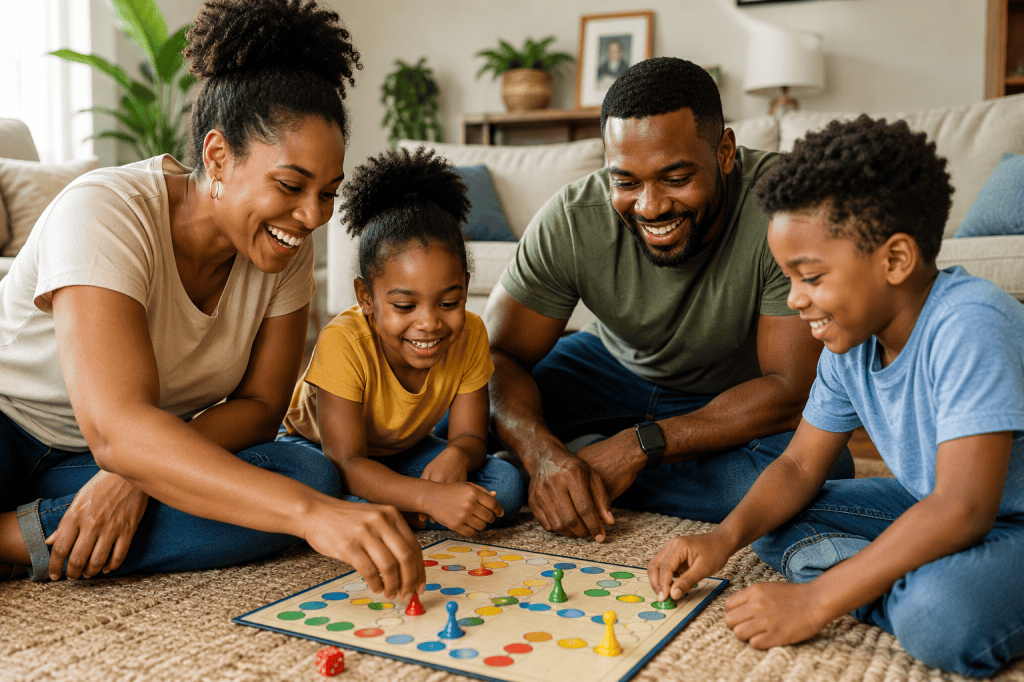
Family connection does not always need a big outing, an expensive activity, or an entire free afternoon. Sometimes ten focused minutes around the kitchen table can do more than an hour spent in the same room on separate screens.
Research on child development supports the value of responsive, back-and-forth interaction between children and caring adults. Harvard’s Center on the Developing Child describes these exchanges as “serve and return” interactions and notes that they support early language, social skills, and healthy development.
The games below are intentionally simple. Most need little or no special equipment, and the goal is not to create another task for parents. The goal is to make it easier to talk, laugh, notice each other, and make memories together.
1. Would You Rather: Family Edition
Take turns asking playful questions: Would you rather have a pet elephant or a pet dolphin? Would you rather cook dinner or wash the dishes? For older children, mix in questions about dreams, school, travel, or family traditions.
Why it works: The answers naturally create conversation. The best part is often the explanation after the choice.
2. Family Charades
Write simple actions, animals, jobs, movie characters, or everyday family moments on small pieces of paper. One person acts while everyone else guesses. Younger children can skip the paper and simply choose something to act out.
3. Flashcard Challenge
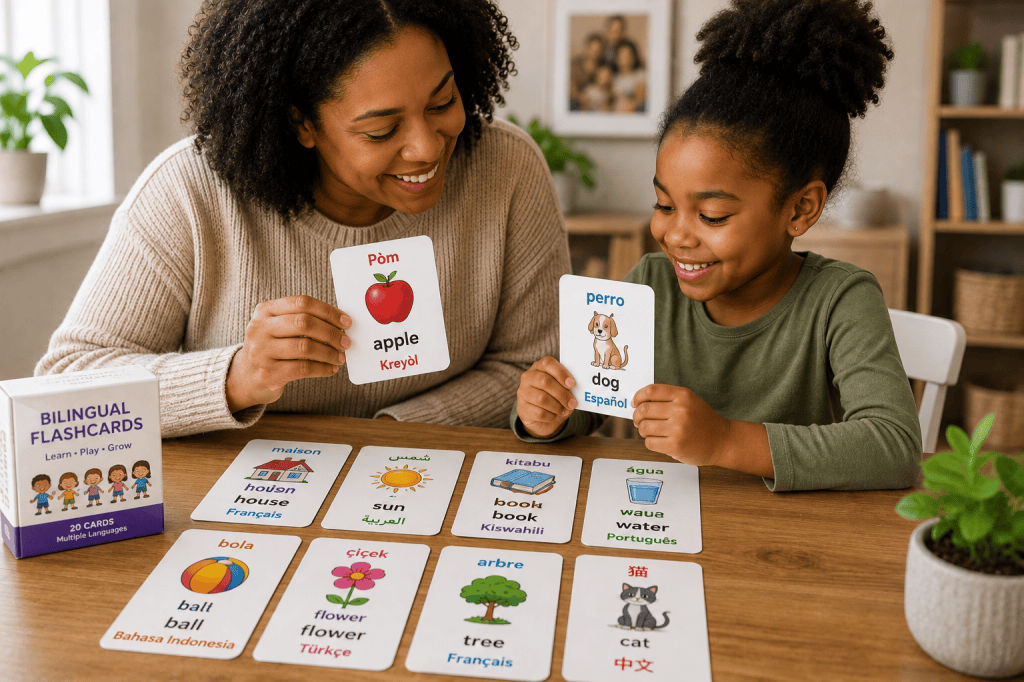
Flashcards do not have to feel like homework. Put a small stack face down and turn it into a family challenge. One person draws a card and has to define the word, act it out, use it in a sentence, translate it into another family language, or give clues without saying the word.
This works especially well in multilingual homes because children and adults can teach each other. Homemade index cards work perfectly, so there is no need to buy anything to play.
4. Beat the Parent
Children love a fair chance to beat the grown-ups. Pick a category such as spelling, multiplication facts, vocabulary, countries, riddles, or quick drawing. Give one point for each correct answer and keep the competition playful.
Let children choose categories where they might genuinely know more than the adults. That is where the fun starts.
5. Two Truths and a Silly Story
Each person shares three short statements: two true and one invented. Everyone guesses which one is made up. For younger kids, call it a “silly story” instead of a lie.
Parents can use funny childhood memories. Children often discover stories about their parents they have never heard before.
6. The Five-Minute Drawing Swap
Everyone starts a drawing for one or two minutes. Then pass the paper to the next person, who must add something. Keep passing until each picture returns to its original artist.
Do not worry about artistic skill. Strange pictures are usually better for laughter anyway.
7. Family Scavenger Hunt
Make a short list: something soft, something older than you, something that starts with B, something that makes a sound, something everyone in the family uses. Play indoors or take the list outside.
For younger children, use colors and shapes. For older kids, make the clues harder or let them design the hunt for the adults.
8. Backyard or Park Obstacle Course
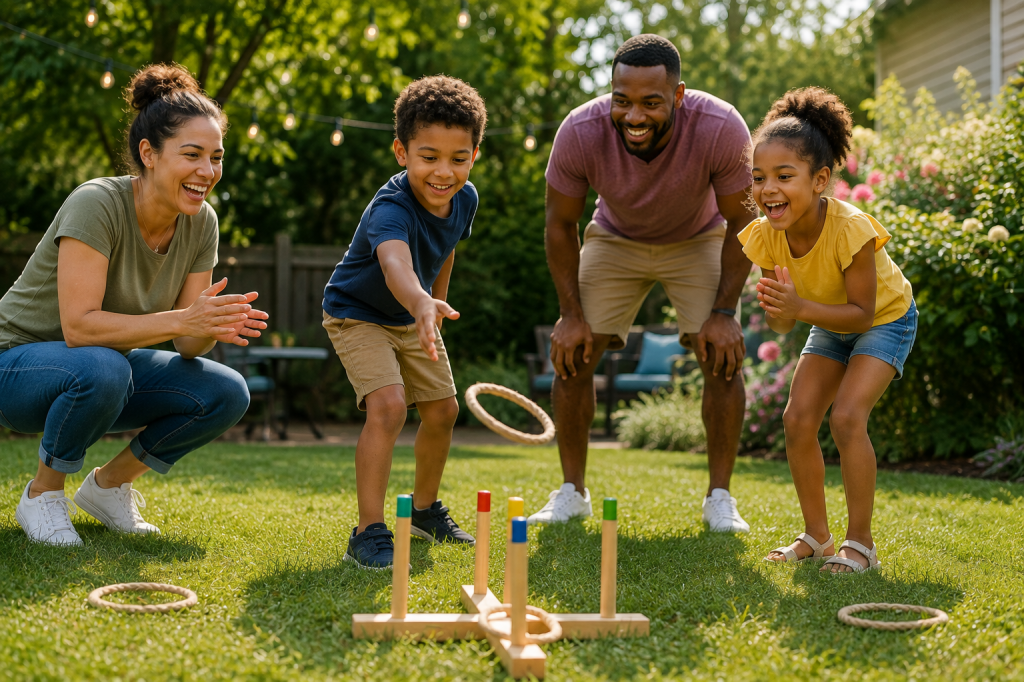
You do not need equipment. Use a tree as a turnaround point, draw a line with chalk, hop ten times, walk backward to a chair, balance a ball, or race from one safe landmark to another.
Let each family member add one challenge to the course. It becomes something the family builds together instead of an activity one adult has to organize alone.
9. Mancala and Haiti’s Twou Kay Tradition
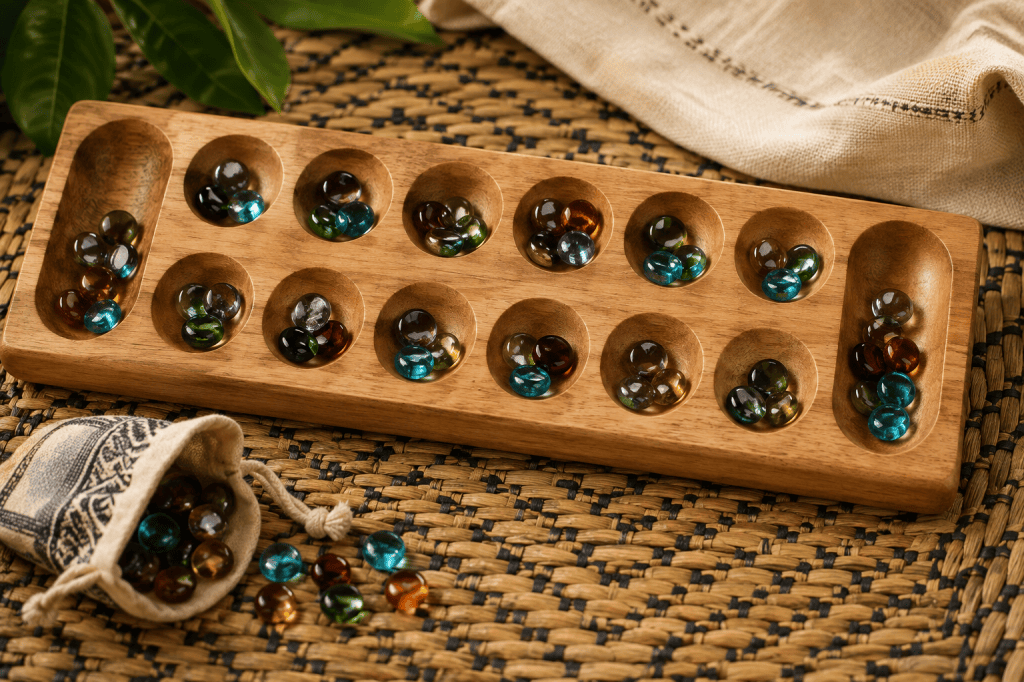
Mancala belongs to a larger family of traditional strategy games played across Africa, the Middle East, the Caribbean, and other parts of the world. In Haiti, generations of families have also played a traditional version commonly known as Twou Kay, using holes or spaces with seeds, stones, or other small pieces. Players count, move pieces, take turns, and plan ahead. Beyond strategy and counting, games like Twou Kay can help families pass cultural traditions and memories from one generation to the next.
10. Family Story Builder
One person begins with a single sentence: “One morning, we opened the front door and found…” The next person adds a sentence, then the next. Keep going until the story reaches a ridiculous ending.
This is especially useful on car rides, while waiting for food, or when you have no supplies at all.
11. Music Freeze
Play a favorite family song and dance. When the music stops, everyone freezes. Add funny rules such as freeze like an animal, freeze on one foot, or freeze with the funniest face possible.
12. High, Low, and Laugh
At dinner or before bed, each person shares three things: a high point from the day, a low point, and something that made them laugh. It is more conversation game than competition, but it can become one of the most useful family routines on this list.
Turn Game Time Into Language Time
If your child is learning a new language, family game time can double as low-pressure language practice. The American Academy of Pediatrics notes that using more than one language does not confuse children, and regular exposure and opportunities to practice matter for multilingual development.
Instead of sitting down for a formal lesson, choose a few words and make them part of a game. Try these ideas:
- Name 5: Pick a category such as foods, school items, colors, animals, or family members. Name five in the language you are practicing.
- Language Memory: Match a picture or word in one language with its equivalent in the other language.
- Vocabulary Charades: Draw a word card, act it out, and have the family guess the word in the target language.
- Beat the Parent: Language Edition: Hold up a card and see whether the child or parent can say the word first. Switch languages for another round.
- Find It: Draw a flashcard, then race to find the matching object, color, or item around the house.
- Make a Sentence: Older children can draw a card and use the word in a simple sentence instead of only naming it.
Picture and bilingual vocabulary cards are especially easy to reuse because the same small deck can become a memory game, scavenger hunt, speaking challenge, matching game, or parent-versus-child competition. The goal is repetition without making the practice feel repetitive.
If your family is learning a new language, bilingual flashcards can make these games easier to repeat at home. Keep this idea bookmarked. We will be adding practical bilingual learning resources for families who want screen-free ways to build vocabulary through play.
Only Have 10 Minutes? Start Here
- 2 minutes: One Would You Rather question for everyone.
- 5 minutes: Flashcard Challenge or a quick drawing swap.
- 7 minutes: Family Story Builder.
- 10 minutes: Charades, Music Freeze, or High, Low, and Laugh.
How to Make Family Game Time Actually Feel Good
The activity matters less than the interaction. Put phones aside when possible, let children have turns leading, and resist turning every game into a lesson. If the family is laughing and talking, the game is already doing useful work.
Harvard’s Center on the Developing Child notes that simple back-and-forth interactions with caring adults can support children’s communication and social development. Play gives families a natural way to create more of those moments without making connection feel formal.
You Do Not Need a Perfect Family Night
A family game night does not need matching pajamas, a decorated snack table, or two uninterrupted hours. Start with one game. Ten minutes counts. A walk counts. Laughing over a terrible drawing counts.
The routine becomes valuable because you keep coming back to each other.
Source note: Child-development context in this article was informed by resources from Harvard University’s Center on the Developing Child on serve-and-return interaction and brain-building through play.
 The Useful Side