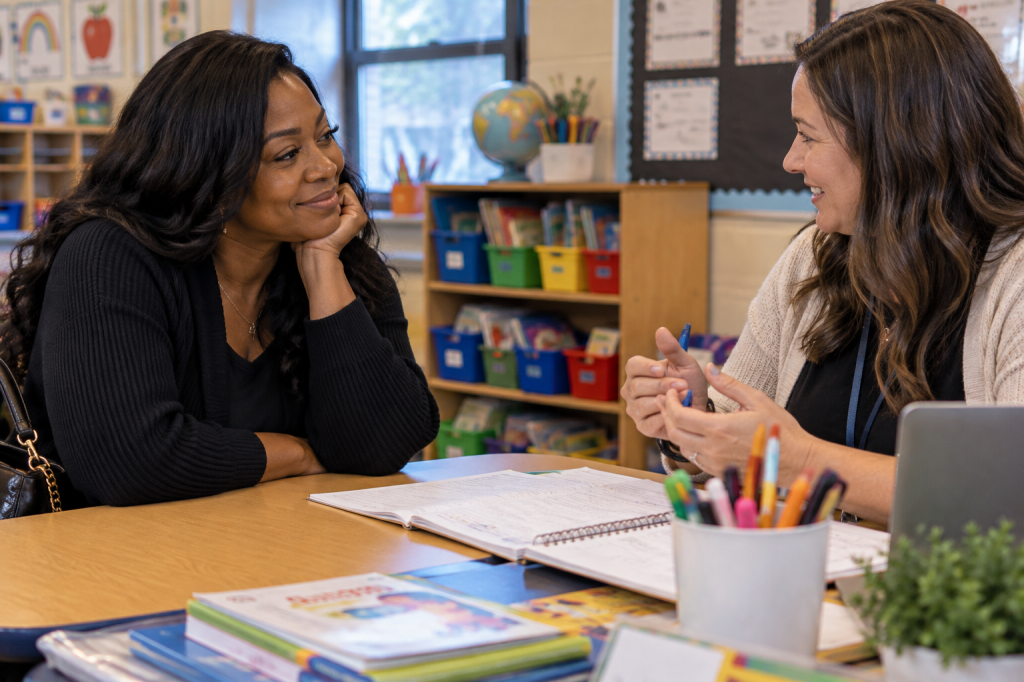
A parent-teacher conference can pass quickly. If you spend the whole meeting listening to grades and test scores, you may leave without understanding what your child actually does well, where they struggle, or what would help next.
You do not need to ask every question on this list. Choose the ones that fit your child and use them to turn a short conference into a useful conversation.
Before the Conference: Ask Your Child First
Before meeting the teacher, ask your child: What feels easy? What feels hard? Who do you work or play with? Is there anything you want me to ask your teacher? Their answers may show you where to focus.
15 Useful Questions to Ask the Teacher
1. What are my child’s strongest areas right now?
Start with strengths. This gives you a fuller picture than beginning only with problems and may show interests or skills you can build on at home.
2. What is the most important area for growth?
“Needs improvement” is broad. Ask the teacher to identify one or two priorities so you know what matters most.
3. Can you show me an example of my child’s work?
A real writing sample, math task, project, or reading response can make feedback easier to understand than a score alone.
4. Is my child working at the level expected for this point in the year?
If not, ask which specific skills are not yet secure and how the school is responding.
5. How does my child participate in class?
A child may know the material but rarely speak, rush through work, avoid asking for help, or participate differently in groups than alone.
6. What do you notice about my child’s friendships and social interactions?
This can reveal whether your child collaborates comfortably, feels isolated, has recurring conflicts, or has strong peer connections.
7. Are there behavior, attention, attendance, or organization patterns I should know about?
Ask for patterns rather than labels. When does the difficulty happen? What usually comes before it? What helps?
8. What support is my child receiving at school?
This might include small-group instruction, intervention, tutoring, English-language support, enrichment, counseling, accommodations, or another service depending on the child.
9. How will we know whether that support is working?
Ask what progress the teacher expects to see and when it will be reviewed. This turns “we’re working on it” into something you can follow up on.
10. What can we do at home that would actually help?
Ask for one or two realistic activities rather than a long list. Ten focused minutes repeated during the week may be more sustainable than trying to recreate school at home.
11. Is there anything we should stop doing at home?
This question is surprisingly useful. A parent may be teaching a math method differently, over-correcting reading, doing too much of the homework, or using a resource that no longer matches what the child needs.
12. If my child is multilingual, how is language development being supported?
Ask how the child is progressing in listening, speaking, reading, and writing; how classroom teachers and language-support staff communicate; and what families can reinforce at home without abandoning the home language.
13. Are there upcoming tests, projects, deadlines, or transitions we should prepare for?
This can prevent surprises and help you organize the next few weeks.
14. What is the best way and time to contact you?
Ask whether the teacher prefers email, a school app, phone, or another system, and what kind of response time is realistic.
15. What should we follow up on, and when?
End with a next step. If the teacher raised a concern, agree on what each person will do and when you should check progress again.
If You Need an Interpreter
Contact the school before the conference and ask what language-access support is available. Do not avoid the meeting simply because English is not your strongest language. Bring your questions in writing if that makes the conversation easier to follow.
If the Teacher Raises a Concern
Ask for specific examples, what has already been tried, what happened afterward, and what the next step is. You do not have to understand every school term immediately. Ask the teacher to explain unfamiliar acronyms or processes in plain language.
A Simple Conference Note Page
- Strengths: ____________________
- Main area for growth: ____________________
- Support school will provide: ____________________
- What we will do at home: ____________________
- Next follow-up date: ____________________
- Question I still have: ____________________
Bottom Line
The best parent-teacher conference is not the one where you ask the most questions. It is the one where you leave understanding your child’s strengths, the most important next step, what the school is doing, what you can realistically do at home, and when everyone will check progress again.
 The Useful Side